
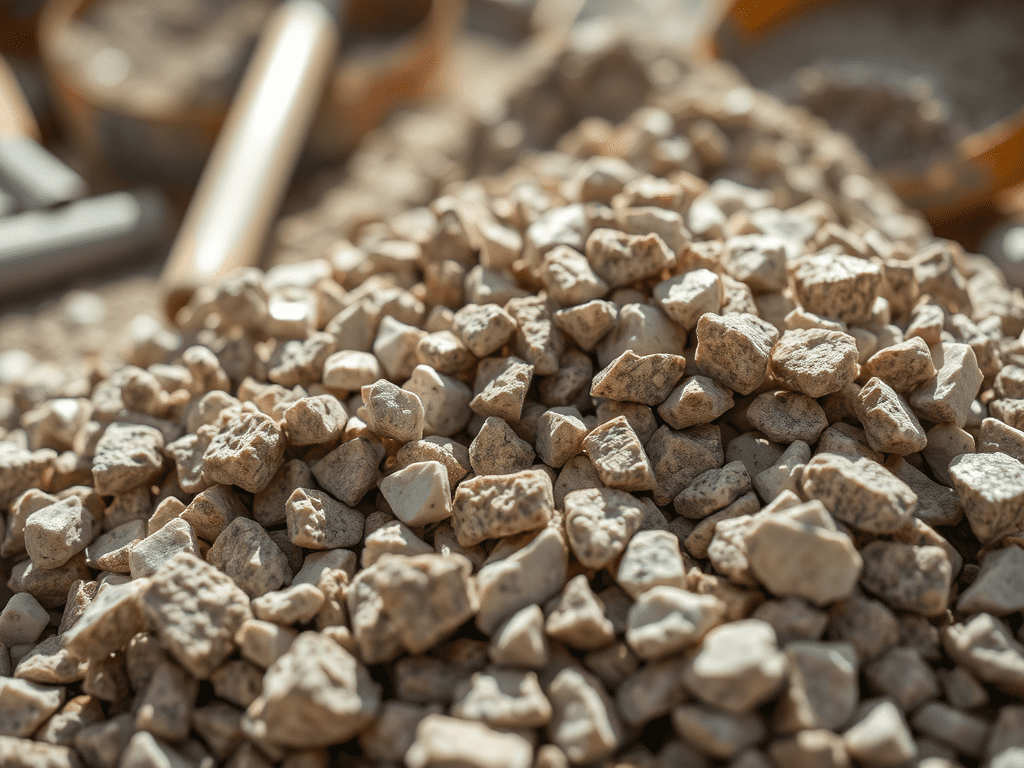
The material you refer to as Gitti (3/4) is the coarse aggregate—specifically, crushed stone or gravel with a nominal size of about 3/4 inch (or approximately 20 mm).This material is a fundamental component of concrete, providing its bulk, strength, and stability.Here is a guide to Gitti (3/4) and the mixing ratios for a perfect house build-up:
1. Understanding Gitti (3/4) in ConstructionGitti (3/4 inch), or 20 mm crushed stone, is the large, primary filler in concrete.
* Role in Concrete: It acts as the skeleton of the concrete mix. The cement and sand (fine aggregate) mixture fills the spaces (voids) between the Gitti, binding everything together into a solid, high-strength mass.
* Ideal Properties: Good quality Gitti should be hard, clean, strong, dense, durable, and free from excessive dust, dirt, or organic matter. Uniform 3/4 inch size is excellent for achieving a strong bond in Reinforced Cement Concrete (RCC) work.
* Primary Use: This size is typically used for all load-bearing structures in a house, including: * Foundations and Footings
* Columns and Beams
* Slabs (Roofs and Floors)
2. The Perfect Mix: Standard Concrete Ratios. The correct mixing ratio of Cement : Sand : Coarse Aggregate (Gitti) is essential for achieving the required strength (Grade of Concrete) for a house.For most residential house construction, the following two nominal mixes (proportions by volume) are typically recommended and are standard practice in many regions of India:| Concrete Grade | Mix Ratio (Cement : Sand : Gitti) | Where to Use (For a House) | Strength (MPa after 28 days) ||—|—|—|—|| M15 | 1 : 2 : 4 | PCC (Plain Cement Concrete) work: Sub-base for floors, non-structural foundations, brickwork mortar. | 15 N/mm² (MPa) || M20 | 1 : 1.5 : 3 | RCC (Reinforced Cement Concrete) work: All major structural elements like Columns, Beams, Slabs, and Foundations that contain steel reinforcement. | 20 N/mm² (MPa) |The Most Important Mix for a Strong House: M20 (1:1.5:3)For the reinforced concrete structures (RCC) that hold up your house, the M20 grade is the minimum standard as per modern building codes.| Component | Proportion (Volume) | Function ||—|—|—|| Cement | 1 Part | The binder that reacts with water to form the paste. || Sand | 1.5 Parts | The fine filler that fills the gaps between Gitti. || Gitti (3/4 inch) | 3 Parts | The coarse aggregate that provides bulk and structural strength. |The Critical Role of WaterThe final component is Water, measured by the Water-Cement Ratio (W/C).
* For M20 grade concrete, the ideal W/C ratio is generally around 0.45 to 0.50.
* Too much water drastically reduces the final strength of the concrete.
* Too little water makes the mix unworkable (difficult to place).
* In simple terms: Use just enough water to make the concrete workable for placing and compacting, but do not exceed the required amount.3. Key Construction Considerations
* Measurement: For small-scale construction, materials are often measured by volume using a bucket or measuring box (formwork). Ensure all materials are measured accurately according to the chosen ratio (e.g., 1 box of cement, 1.5 boxes of sand, 3 boxes of Gitti).
* Quality Control: Always use clean, potable water. Ensure the sand is clean and free of silt and clay. The Gitti should be washed if it appears dusty or dirty.
* Consultation: Always consult a qualified Civil Engineer or Architect for your specific project. They will assess the design, soil conditions, and load requirements to specify
Tips for Sand Gravel
From Foundation to Finish: Your Guide to Sand and Gravel in Assam Household Construction
Assam, with its unique topography and heavy monsoons, presents a specific set of construction challenges and opportunities. For any house builder, understanding the local materials is key to a strong, durable, and beautiful home. At the heart of most construction projects are two simple yet indispensable materials: sand and gravel.
These aggregates are more than just fillers; they are the backbone of your building. Let’s delve into how you can best utilize sand and gravel in your Assam household construction, from the foundation right up to the finishing touches.
Part 1: Essential Uses of Sand and Gravel in Your Home
Sand and gravel, often referred to as aggregates, play distinct and crucial roles in almost every phase of construction.
- The Power Duo in Concrete and Mortar
This is their most vital role. Sand, especially coarse River Sand (often sourced from the Brahmaputra and its tributaries) or Manufactured Sand (M-Sand), mixes with cement and crushed stone (gravel) to form concrete.
- Gravel/Crushed Stone (Gitti): As the “coarse aggregate” (typically 6 mm to 20mm in size), it provides bulk, compressive strength, and stability to the concrete used in:
- Foundations and Columns: The structural skeleton of your home.
- Roof Slabs (RCC): Ensuring a sturdy, load-bearing roof.
- Beams and Slabs: Critical structural elements.
- Sand: As the “fine aggregate,” it fills the voids between the gravel, improving the concrete’s workability and binding strength. It is also the main ingredient in:
- Mortar: The ‘glue’ that holds bricks and blocks together.
- Plaster: Mixed with cement for a smooth, finished wall surface.
- Enhancing Drainage and Foundation Stability
Given Assam’s heavy rainfall, effective water management is non-negotiable.
- Gravel Base: Before laying a foundation, a layer of compacted gravel or crushed stone serves as an excellent sub-base material. Its coarse nature promotes swift water drainage, preventing water pooling and keeping your foundation dry and stable. This is critical for preventing soil erosion and structural damage, especially in flood-prone areas.
- Backfilling: A mix of coarse sand and gravel can be used for backfilling around the foundation walls, further aiding in drainage and compaction.
- Pathways, Driveways, and Landscaping
Beyond the main structure, aggregates add utility and aesthetic appeal to your home premises.
- Paving Base: Fine sand and stone dust are used as a bedding layer beneath paving stones or tiles for driveways and walkways, providing a level, compactable, and stable base.
- Decorative & Drainage Gravel: Pea Gravel or small, rounded river stones can be used in your garden and lawn for decorative pathways, improving the landscape’s drainage, and acting as a durable alternative to grass in high-moisture areas.
Part 2: Expert Tips for Assam Household Construction
Building in a region like Assam requires mindful material selection and construction practices. Here are some key tips to ensure durability against the local climate.
- Focus on Quality and Cleanliness
The quality of your aggregates directly impacts the strength of your construction.
- Check for Silt and Clay: River sand often contains high amounts of silt and clay. These impurities weaken concrete and mortar, as they prevent proper bonding with cement. Always ensure your sand is thoroughly washed (washed sand) or opt for high-quality M-Sand, which has controlled particle sizes and fewer impurities.
- Gravel Hardness: Use hard, strong gravel (Crushed Stone/Stone Chips) for all structural concrete. Stones with a higher crushing value will give you a stronger mix, which is essential for withstanding the region’s climate-induced stresses.
- Master the Right Mix Proportions
Don’t rely on guesswork. Using too much sand or too little cement will compromise structural integrity.
- Structural Concrete (RCC): For columns, beams, and slabs, a typical strong mix is M20 (a general standard), which has a 1:1.5:3 ratio (1 part Cement : 1.5 parts Sand : 3 parts Gravel/Coarse Aggregate). Consult your structural engineer for the exact ratio.
- Plaster Work: Fine sand (Plaster Sand or P-Sand) should be used. A leaner mix (more sand) will crack, and a mix too rich in cement will be difficult to work with and cost more. A common mix is 1:4 (1 part Cement : 4 parts Fine Sand).
- Prioritize Drainage with Gravel
Given the high water table and monsoon season in many parts of Assam, drainage is crucial.
- French Drains: Consider installing a perimeter French drain around your foundation. This involves digging a trench and filling it with coarse gravel (with a perforated pipe) to channel rainwater away from the foundation. This simple application of gravel can save your home from water damage.
- Floor Base: For the ground floor, lay a solid base of compacted gravel/crushed stone before the final concrete floor slab to act as a moisture barrier.
- Storage and Handling Tips in the Humid Climate
The high humidity and frequent rain in Assam affect how you must store and handle your aggregates.
- Avoid Ground Contact: Always store your sand and gravel on a clean, dry surface, ideally on concrete, or use tarpaulin sheets to prevent contamination with soil, mud, and organic matter.
- Protect from Rain: Cover your aggregate piles with waterproof sheets during the monsoon season. Wet aggregates lead to an inconsistent concrete mix as the water-cement ratio is impossible to control, reducing the concrete’s final strength.
- Account for Moisture: Always test the moisture content of your sand before mixing concrete. If the sand is already wet, you must reduce the amount of water added to the concrete mix to maintain the prescribed Water-Cement Ratio (W/C ratio). This is a small step that dramatically improves your concrete’s strength and durability.
By understanding the unique properties and roles of sand and gravel, and applying these local, climate-conscious tips, you can ensure that the foundation of your home is as strong and enduring as the spirit of the region itself.
the exact concrete grade and mix ratio that ensures the structural safety and longevity of your home.